Image: Artwork image rights managed by holding institution; source link provided
View source →The Red Armchair
Pablo Picasso, 1931
Technical Details
Medium
Oil and Ripolin on panel
Dimensions
131.1 × 98.7 cm (51.6 × 38.9 in)
Style
Surrealism
Decade
1930s
About This Work
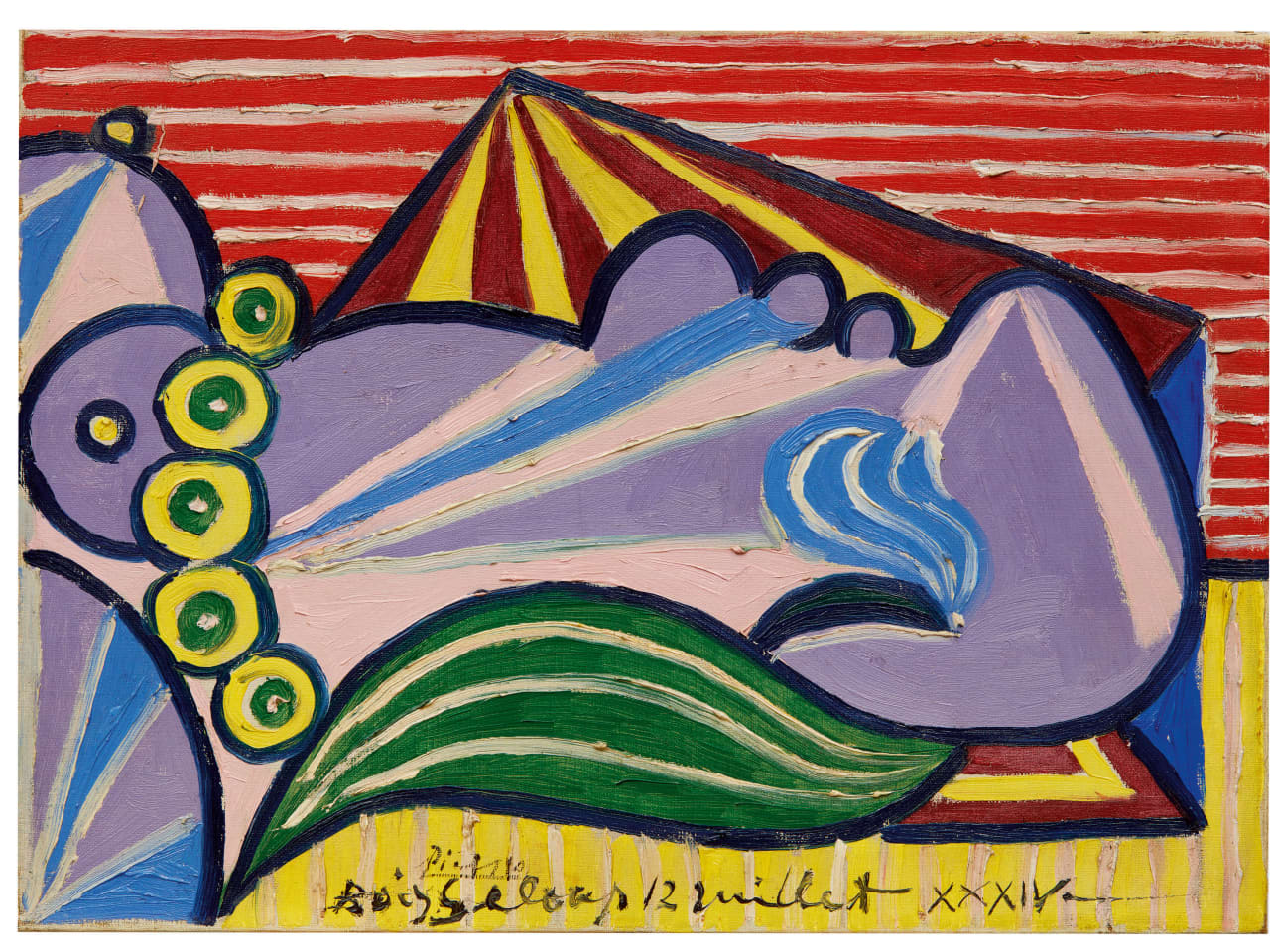
Executed on December 16, 1931, The Red Armchair is a striking Cubist-inflected portrait of Marie-Thérèse Walter, Picasso's clandestine muse and central subject during the early 1930s. The composition portrays the seated figure against a vibrant background of contrasting yellow, green, and purple hues, embodying the intense psychological resonance and formal innovation of Picasso's Surrealist period. A defining feature of this work is Picasso's radical synthesis of facial perspectives, wherein a single head simultaneously displays both frontal and profile views, creating a complex, multifaceted optical presence. Furthermore, the painting highlights the artist's pioneering experimentation with industrial house paint known as Ripolin, blended with traditional oil to achieve varied surface textures, ranging from tactile, rough impasto backgrounds to crisp, brushless black contour lines. The bold chromatic contrasts and curvilinear geometry convey both domestic intimacy and monumental psychological weight, establishing a timeless benchmark of modern portraiture.
Painted in December 1931 at the height of Picasso's clandestine relationship with Marie-Thérèse Walter, this masterwork captures a watershed moment in the artist's personal and creative trajectory. While formally married to Olga Khokhlova, Picasso maintained a secret domestic and artistic sanctuary where Walter inspired an unprecedented outpouring of sensuous, psychologically charged portraits. The painting reflects the dualities of Picasso's life during this period, encoding subtle psychological tension within domestic iconography. Historically significant for its early adoption of commercial Ripolin enamel alongside oil, the work bridges traditional easel painting with avant-garde material exploration. It was exhibited widely in landmark international retrospectives, including the pivotal 1932 exhibitions at the Galerias Georges Petit in Paris and the Kunsthaus Zurich. Later acquired by the Art Institute of Chicago in 1957 as a gift from Mr. and Mrs. Daniel Saidenberg, The Red Armchair has remained an essential pillar in public scholarship regarding Picasso's transformation of portraiture and material technique during the interwar era.
Current Location
Art Institute of Chicago, Chicago, United States
Public Collection — Open to visitors
Visit museum website →Collection record status
Live institutional record fetched.
Source-linked entry contains a provenance or acquisition statement; full ownership-chain claims remain limited to the cited institution.
Image access: Permission required.
Valuation & Provenance
2026 Estimated Value
Public collection / market value not asserted
* Estimates are based on comparable auction results and market analysis. Not a formal appraisal.
Last Known Sale
No public auction record — held in permanent museum collection
Keywords
Continue Exploring
Related Artworks
Chosen for shared style, era, medium, subject, or date.
Shop Related Products
If you love this surrealist period masterpiece, explore these curated books and resources on Amazon.
Picasso: A Biography by John Richardson
Comprehensive biography exploring Picasso's life and artistic evolution
The Weeping Woman Art Print
Striking Surrealist portrait from Picasso's emotional period
Picasso: A Life Documentary
Comprehensive documentary chronicling Picasso's entire artistic journey
As an Amazon Associate, we earn from qualifying purchases. Each product link is unique to help us track which recommendations resonate most with our visitors.